
Mark Rowlands
Mark Rowlands (born 1962) is a Welsh writer and philosopher.
I was 27. I was in my first real job at the University of Alabama, in Tuscaloosa, Alabama. I was having a great time, but I missed dogs. I’d grown up with large dogs. And I thought, since it looked like I was going to be here for a while, maybe I should consider getting a dog. So, I was leafing through the local newspaper, pre-internet times, of course, and an advert jumped out at me: Wolf Cubs for sale 96%.
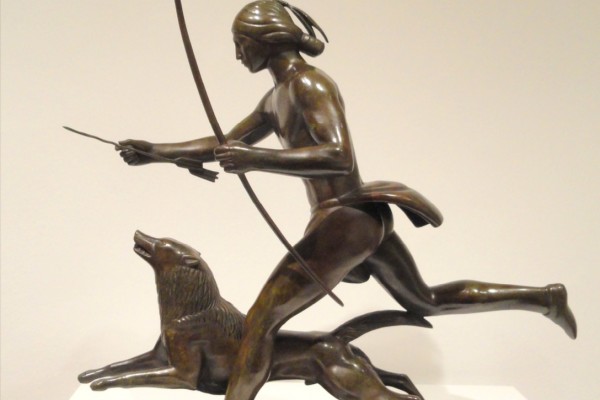
I thought, well, this is something I’ve got to see. And, so, I came to acquire Brenin – he was sold to me as a wolf but I’m pretty sure he was a wolf-dog mix, a wolf-malamute mix.
We spent the next 11 years, living and travelling together. Brenin had certain issues, notably severe separation anxiety. If I left him on his own, even for a few minutes, he would destroy everything he could lay his jaws on. Anything that wasn’t screwed to the ceiling was fair game as far as he was concerned. The cardinal rule was, at no point was he ever to be left on his own. And so, the classes I taught at the university of Alabama, I basically had to take him in with me. Any socialising I did, bars and parties, he would come along too. And as part of this arrangement, I decided it would probably be a good idea if he were kept constantly exhausted, and thus began my life of running as an adult. Unfortunately, if predictably, he was much better at running than I was, and so I tended to be the exhausted one, not him. But I did the best I could.
I’m going to be 60 years old next month, and my knees are shot. The menisci that remain are wafer thin, and prone to tears, which I’m told there’s no point trying to fix any more. They heal on their own, but it takes a long time. So, it seems these days I’m either out injured or coming back from injury, neither of which are much fun. So, I still run when I can, but it is not always the regular occurrence of old.
Well, I run when I can, and I do other things. The art of getting old is learning to train around injuries and other infirmities. I do quite a bit of strength work now, weights and so on. Not barbell squats of course – that’s a lumbar herniation waiting to happen. I still do martial arts, boxing especially, but mostly on bags now because I’m not as quick as I used to be, and I don’t really care for people punching me in the face. I get the cardio in whatever ways I can. I get on a bike quite regularly, even though I don’t like it as much as running. But, generally speaking, I just do what I can when I can.
I can only describe how it works for me. I only walk if I can’t run, so I can’t really speak to the cognitive benefits of walking. I think for me, the benefits of running mirrored the way I used to write when I had the time to do this. The method was quite brutal and amounted to what I think is a form of ego-depletion. First, I would sit down for eight hours and just write. No interruptions – that doesn’t happen anymore – just writing. But that was just setting things up. After around eight hours or so, when my brain was completely fried, that’s when the interesting stuff started to happen – at least, I thought so. Before that, any thought or idea that emerged had ‘me’ stamped all over it. I had one of those thoughts, and I would think to myself: “oh, yes, that’s just what I would think”. Not very interesting. But when the brain gets exhausted enough, more interesting things start to happen. Then thoughts start appearing – showing up, unannounced. And I’m not really sure where they came from. The thoughts that emerge in the first eight hours, they would be sort of sifted and sieved through a kind of a framework for thinking about things, a way of looking at things that is, basically, me. But this framework can be broken down through the right sorts of exhaustion. Then more interesting ideas start to emerge. It’s as if the thinker has gone but the thoughts keep on coming and they are much more interesting than thoughts tethered to a thinker. I think, for me, running was an extension of this kind of method.
First, when I would start out there would be the embodied stage. Basically for this stage, I’d be worried about what injury was going to manifest itself that day. Therefore, I would be highly attuned to any bodily disturbances; keenly aware of my body – especially serial offending parts of my body such as my calves, which were a perennial thorn in my side. Today, to be honest, I’m more likely to be attuned to the tightness in my chest rather than my calves, but the principle remains the same. In the embodied stage, I am focused on the body and things going on in it. I am this body.
After a while, when the tiredness begins to take hold, I forget about the body. This is the second phase. Now, the body is no longer me, but a tool or instrument I am using to get what I want. I make deals with this body – “Just get me to the corner of Old Cutler Road and 104th Street, and then I’ll let you walk for a bit.” I am the one making the deals – a thinking subject with its bodily puppet. This is, in many ways, like Descartes’ view of the person. Therefore, I labelled it the Cartesian phase.
As the run continues, miles later, the thinking subject also seems to fade into the background. Now, there are just thoughts, one flowing into another, and it is not quite clear where they come from or where they’re going, or what they mean even a lot of the time. And this struck me as something like sort of David Hume’s account with the self. In his account, there is not a thinking subject, a thinking thing in the way Descartes thought there was, there was just a collection or bundle of thoughts. I, therefore, christened this phase of the run the Humean phase.
The final phase only comes when I’m very, very tried. I realise that none of these thoughts are really me at all. But I’m nothing at all. I named this phase after Sartre, who famously claimed that consciousness is nothingness, it’s a wind blowing towards the world, and nothing else.
I once ran the Miami marathon after a severely curtailed training regime – my calf went, and I couldn’t run for the two months leading up to the race. I think I never properly understood Sartre’s notion of freedom before this. When Sartre talked of freedom, I think he understood freedom in terms of the idea that your motives can never compel you. We are all, in this sense, beyond the authority of motives – and related states such as decisions. Around the 16-mile mark, I was very tired, in quite a bit of pain, and very motivated to stop. But I realised this motive had no power over me. It can’t make me do anything at all. I think that’s the sort of idea Sartre had in mind when he talked about freedom. Our motives cannot compel us. We stand outside, or beyond, the authority of our motives in this sense. Nothing you have chosen, nothing you decide, nothing you choose can make you do anything at all. And to this extent you’re free.
Well, in that particular circumstance, the feeling was elation, realising that I’m beyond the authority of motives. Sartre on the other hand, possibly a rather negative person, talked of anguish. The experience of freedom is an experience of anguish. If so, then I suspect anguish can sometimes be quite pleasant.
That’s the trillion-dollar question. I’m coming around to the idea that the ability to laugh at yourself is crucial. Sometimes, say when a run is going particularly badly – an increasingly common occurrence – I can’t help bursting into laughter at how hopeless I am now. Camus concluded his study of the myth of Sisyphus with the observation – perhaps it was advice – that one must imagine Sisyphus happy. Humour is one of the most important forms of defiance we can bring to bear on our own decline. The Philosopher and the Wolf was all about defiance, and as a still youngish man I tended to think of this as shaking your fist at the world. By the time I wrote Running with the Pack, then the idea of defiance had expanded to things like compassion, universal compassion in the face of a very brutal and unpleasant world whose basic design principles seem to leave very little room for it. Compassion is a form of defiance too. I would now expand that list to humour, including self-deprecation. We can’t take ourselves too seriously – the world certainly doesn’t.
Am I nicer now? That’s for others to say. I’ll have to ask around. And if I’m not then, well, everyone will just have to be patient. But seriously, I think you’re right in the sense that experiencing vulnerability yourself allows you to empathise with others and their vulnerabilities more easily.
I certainly hope not, because that is something we’re going to lose. No, that was a specific example of a highest moment, but I wouldn’t want to suggest that they’re linked to physical wellbeing though. I think some of your highest moments can be linked to the lack of physical wellbeing.
Well, this idea of, time takes everything from us in the end, right? What redeemed us in The Philosopher and the Wolf at least was our defiance: it is only our defiance that redeems us. I don’t disagree with this, but my understanding of defiance has broadened over the years.
Camus concludes his study of the myth of Sisyphus, he concludes it with, “One must imagine Sisyphus happy.” When Sisyphus laughs at these gods, these enormously powerful, but nevertheless petty and vicious beings that have imposed this punishment on him, there’s nothing else he can do. Not even die. But, in his contempt for the gods and his refusal to be broken by them, he possesses a kind of dignity and happiness of a sort. This happiness-born-of-defiance was Sisyphus’s highest moment.
For us, time plays the part of the gods. And I think our highest moments too are probably all ones of defiance, but in a broader sense than I envisaged when I wrote The Philosopher and the Wolf. A defiance that incorporates compassion when it’s needed, and the ability to laugh at yourself in the face of your decline.
It’s mostly by accident, as most good things in my life are. I think in part, I became interested in the phenomenological tradition of philosophy quite early on when I was an undergraduate student. And that’s tended to shape a lot of my thought about various things. Wearing one of my other hats, for example, involves me thinking a lot about embodied, embedded, enacted, and extended cognition. And my defence of this general way of looking at the mind – 4E cognition, as it has become known – is influenced by phenomenologists such as Husserl and Sartre. I was also fortunate to spend quite a bit of my adult life in France. I learned the language, and I became capable of reading it, haltingly. And so, when the mood took me, I was able read Sartre and Camus in French, which might explain some of my fondness for them.
There is no independent, objective, standard relative to which we can compare and grade things like intelligence versus things like speed or endurance. Arguably, I can string a sequence of thoughts together better than a wolf. But a wolf can run much better than I can. We humans are inclined to say, “Yes, but thinking is more important than running.” But then the question is, well, by what independent, objective standard can you make this judgment? It is difficult to imagine what such a standard would even look like, still less what could justify it. For us, thinking may be more useful given the kind of world we live in. But, for wolves, running is far more important. And that, I think, is all there is to it.
What was most valuable wasn’t a specific idea or conclusion but a method of thinking, that complemented and reinforced the method I brought to writing. This method involves breaking down me – chipping away at the framework through which I see and think about the world – and finding out what happens then. It’s hard, brutal work, sometimes experientially very unpleasant. That is something that thinking and running have in common.