Award-winning wildlife and landscape photographer Michael Poliza
Zan Boag: You have spent many years of your life on the road, moving from one country to the next. What does ‘travel’ mean to you?
Michael Poliza: For me it was never about ticking off places, I was always curious to explore and to see places. I’ve travelled to metropolitan areas and to cities but for me really it’s about going to wilderness areas, that’s where I’m happy, there with my camera in my hand, snapping away and taking pictures. It’s not even a job for me, it’s pure pleasure. That really comes out only in wilderness areas, I hardly grab my camera when I’m in cities. In the bush I enjoy the disconnect, that I’m adjusting to nature’s schedule rather than any other schedule, a schedule that I’m setting or someone else is setting. The other thing that the wilderness taught me is that although I can be an impatient person in my normal life with human beings, I become a rather patient person when it comes to animal photography.

How important is the idea of ‘adventure’ in your life? Is adventure an important part of everyone’s life?
I sailed around the world on a ship for three years going past Australia and New Zealand and other places, and I took a helicopter from Hamburg to Cape Town. And people started asking me: “What are you going to do next, go to the moon or something?” But it was never about that. When I took the ship around the world it was about going and seeing places that are so hard to reach and would have been impossible to go to otherwise, and just spending time there. The journey was just to get there – even though I enjoyed the journey on the ship and it was certainly an adventure, it wasn’t about the thrill. I’m not a thrill-seeker, per se. Taking the helicopter from Hamburg to Cape Town wasn’t about thrill seeking – I don’t mind having a bit of fun sometimes – but it wasn’t about the adventure, it was more about the opportunity to see pretty much everything between Hamburg and Cape Town and to see how the landscape changes and the culture changes and the music changes, and the colours change, in a way in slow motion. If you jump on a plane, fly for 10 hours, or 25 hours, and you wake up on the other side of the world then you miss everything that’s in between. One of the reasons we went by ship – by slow ship – was to feel the distance.
What are you seeking personally in your travels? What do you hope to find when you’re roaming the world?
I’m looking for experiences. I want to see things, I want to explore, I want to see the beauty of nature. And I want to capture the harmony of nature. I love standing on a hill and realising that there are very few humans around, apart from the few people I might be with, and there are no signs of civilisation – no transmitting towers, roads, houses, buildings, power lines – just the way nature created it, and I love that.

Is there a moment that stands out for you in your travels, something significant that occurred while you were on the road?
Rather than one moment, it’s probably been a slow build-up, a realisation over time how important nature is to me. After three or four weeks in the wilderness I’m happy to go back to civilisation, then I get nervous and I need to go out into the wilderness again.
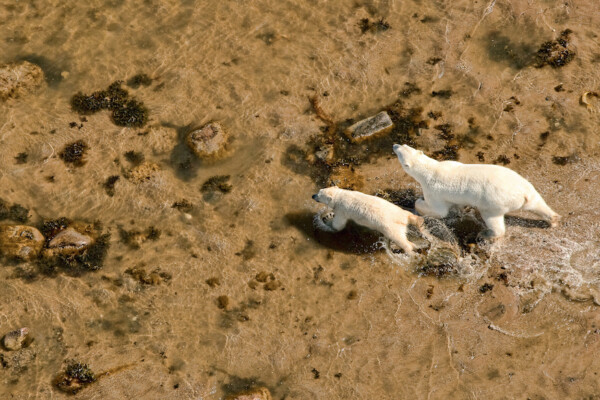
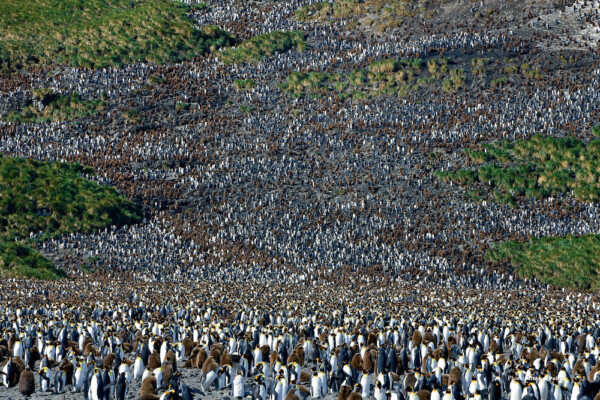
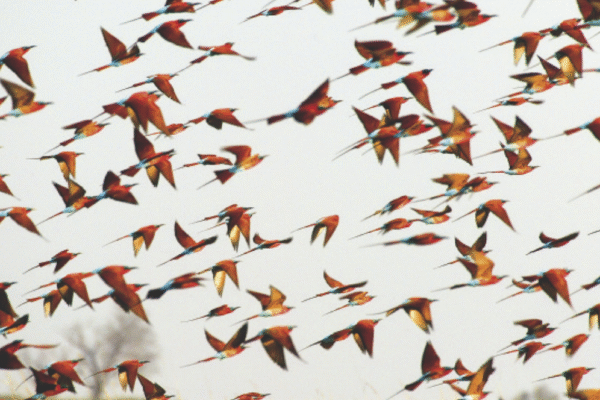
Looking specifically at your photographs of animals migrating: what have you learned from watching and photographing these groups of animals moving in unison?
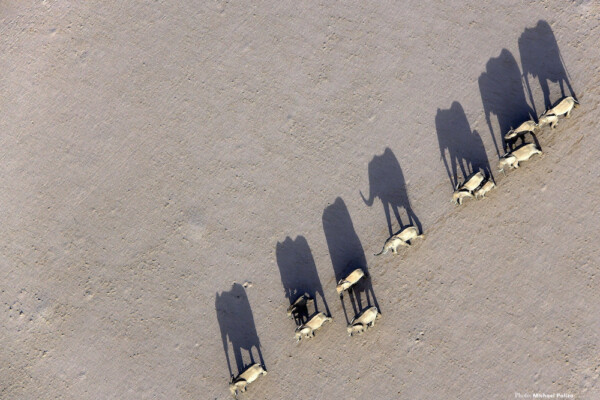
When it comes to photography I focus on pretty much any wild animal. When you spend time in the wilderness observing animals and waiting for that wonderful shot – that is somewhat different to all the other shots that you’ve seen – then you start observing and you start learning things about animals. Many animals are relatively predictable – by their behaviour you can see whether they’re agitated, or aggressive, or scared. Not 100 per cent predictable, but you have a feeling of what might happen next. And that has been useful, because in animal photography you are an opportunist, you have to take what nature gives you. But it’s not about taking the one millionth shot of a leopard, lion or elephant, it’s about trying to get a shot that people haven’t seen, or that feels a little bit different, that captures the motion, or tells a story. It’s not so much about documenting the animal but capturing a mood as well, about emotions, about something that happens to you when you look at it.
And this is what you’re trying to convey through your photography – a mood?
I think that one of the messages that I would like to get across, something that I have realised – the subconscious message from the very beginning was about the beauty of nature, and the positive aspects of it. True wilderness areas are becoming smaller and smaller and animals’ habitats are being threatened by development, but I also want to convey a message that there is still enormous beauty out there and it’s not too late to do something about it and to feel responsible for it.

Are humans so different from other animals?
It’s difficult to judge all humans… but the sense of superiority, of putting ourselves above animals is one of the bigger differences. The feeling that we are here to manage the world. Humans are a different breed of animal – the conscience, the precise communication, the sense of self, all of that. We think we’re far superior, and if it’s only that – well, I don’t think other animal species have that feeling of superiority.
Is there anything else you’d like to add, anything you’d like to convey to our readers?
I can only encourage everybody to enjoy nature and feel responsible for nature. I think we only feel responsible for things that we have an emotional connection to. With all the negative press every day, we cannot feel responsible for everything, but we can feel responsible for the things that are closer to us and I hope many people will build a stronger, more emotional connection to the remaining wilderness areas, to the animals and their natural environment.