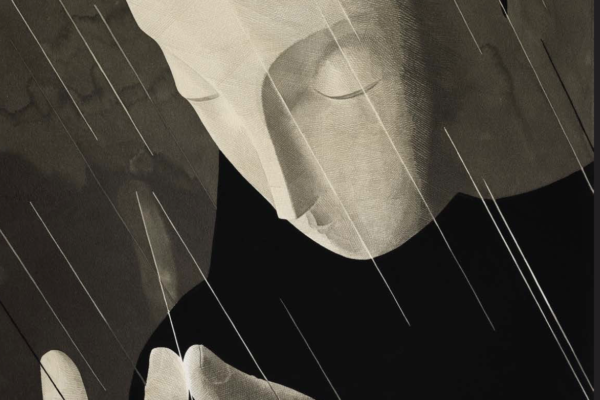

If there were a word to sum up the human condition for South Korean artist Daehyun Kim, it would be conflict. It’s a topic he invariably explores in his work. “It is no exaggeration to say that conflict is the subject of almost all of my paintings,” he says.
As a child, Kim wasn’t encouraged by his parents to think in any particular way; instead, he was given the freedom to ruminate and interpret the world as he wished. “My parents didn’t care so much about my studies or my future education,” he says. “I never worried about grades. Nor was I given advice to help me get through life – advice about what is good and what is bad in the world. I was not taught about what to stay away from and what to pursue. Coming into the world with no established values, I found myself asking: What is the meaning of life?” Although this upbringing would have contributed to Kim’s exceptional creative output as an adult, he says it hindered him in other ways. In particular, he struggles to make decisions in ordinary life. “Whenever I have to make a choice, I experience severe internal conflict,” he says.
Possibly due to this, Kim always prepares his images digitally before he sets down to draw by hand, giving him the freedom to change his mind. “Usually, the digitally-completed image is used as a reference,” he says. “And then I draw it again using an analogue technique.” Almost all of his works are done with ink on acrylic paper, produced from the living room in his house.
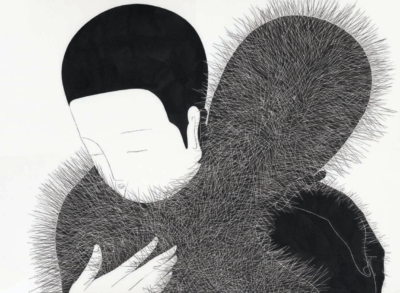
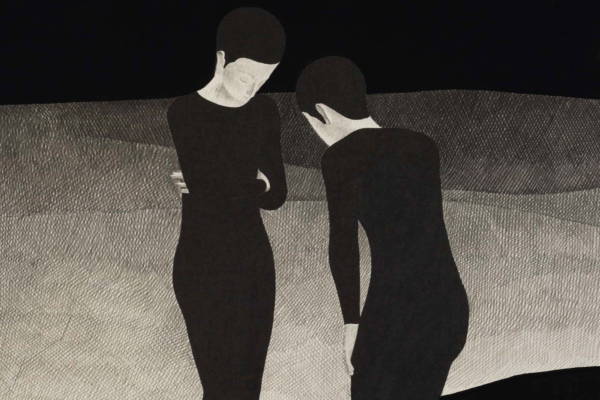
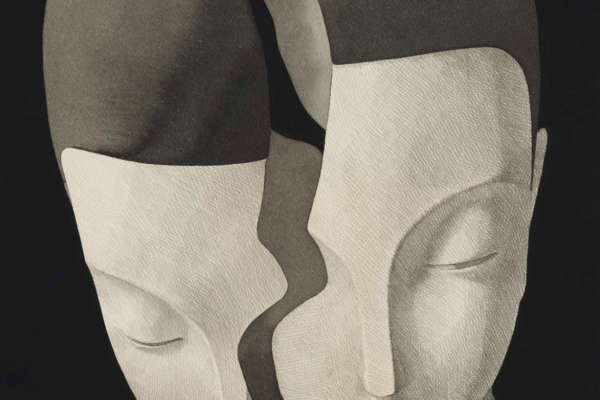
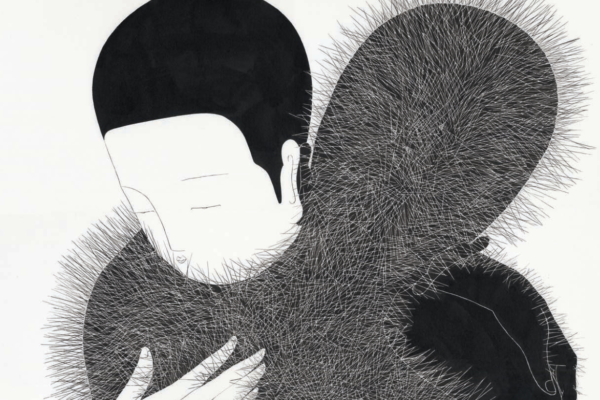
Themes of inner conflict are typically played out in his work by two or three figures representing the different desires of the inner self. “You often want to get help from others,” he says, “but at the same time you don’t want help. Love and hate; thinking about death and on the other hand revealing a strong will to live – such contradictory thoughts and emotions make us human.”
How is conflict handled in Korean culture? “Koreans are conscious of the gaze of others, and they value manners,” responds Kim, but they generally don’t sum people up on first meeting. Older Koreans, he says, tend to give younger generations unsolicited advice on personal matters. “Older adults can give straightforward advice to the younger generation, which can become a factor in intergenerational conflict.” But it’s not just intergenerational conflict that Kim notices in daily Korean life, it’s also conflict between people from different regions, between rich and poor, and conflict between genders.
“Conflicts will always exist; when one conflict is resolved, another will emerge,” he says. “As for avoiding conflictual situations, I think half of it has already been solved just by facing it with courage. Like the sense of solitude or emptiness felt while living as a human being, inner conflict is also regarded as a condition present from birth.” But, he concludes, “If you are a person who can resolve your inner conflict, it won’t be that difficult for you to mediate any conflict with others.”