Emotions can hijack our minds. They prepare us for action, and they neighbour our perception. But they also reveal what matters to us most. […] The basic emotions – anger, fear, sadness, disgust, surprise, and happiness – are universal, recognisable across cultures and even species. They are short-lasting but powerful, automatic responses that help us navigate our social world. But we also develop complex emotions that blend these basic ones. And importantly, we can learn to recognise the micro-expressions and subtle cues in others’ faces to understand their emotional states. This is not just useful – it’s a moral imperative. Being emotionally literate increases our capacity for empathy, understanding, and peaceful coexistence. Emotional awareness, then, is not only about control but about connection.
– Paul Ekman, Emotions Revealed
There are between 6 and 8 basic human emotions, or so most theories suggest. Psychologist Paul Ekman lists joy, sadness, anger, fear, disgust, and surprise, while psychologist Robert Plutchik adds trust and anticipation to the mix. These basic emotions can be combined in multiple ways – for example, fear plus joy, the blending of two contrasting emotions, creates excitement. Consider the feeling of waiting in line for a roller coaster ride: your heart races with fear and joy simultaneously.
The blending and contrasting of emotions has intriguing parallels to colour theory. In art, primary colours (red, yellow, blue) mix to produce secondary colours (orange, green, purple), while tertiary colours arise from mixing a primary with a neighbouring secondary colour, creating hues like red-orange or yellow-orange. Paint manufacturers often give these secondary and tertiary colours more poetic names, such as vermilion or scarlet for red-orange, and amber or marigold for yellow-orange.
In 1962, Plutchik went so far as to arrange his eight primary emotions on a wheel, inspired by the colour wheel, placing contrasting emotions opposite each other (joy opposite sadness; surprise opposite anticipation). Each primary emotion has three levels of intensity. Joy, for instance, can range from serenity at low intensity, to joy, and finally to ecstasy at its peak. Anger can similarly range from mild annoyance, through anger itself, to full-blown rage – the emotional equivalent of fire-engine red. The ‘spaces’ between primary emotions are filled by blends of two emotions: joy combined with trust yields love (much like red and yellow make orange), while fear and surprise together can create awe.
Although Plutchik’s ‘Wheel of Emotions’ may be somewhat simplistic, it underscores that emotions exist along a spectrum, vary in intensity, and often occur in complex blends rather than as isolated states. Just as an artist carefully creates a colour palette when creating an artwork, our lives, too, are shaped by emotional blends. By consciously adding more positive emotions – like serenity, acceptance, and interest – we not only increase our capacity for joy, optimism, and love, but we can also soften the intensity of the less favourable emotions that we experience in life.
From the Emotion edition, available via our online store
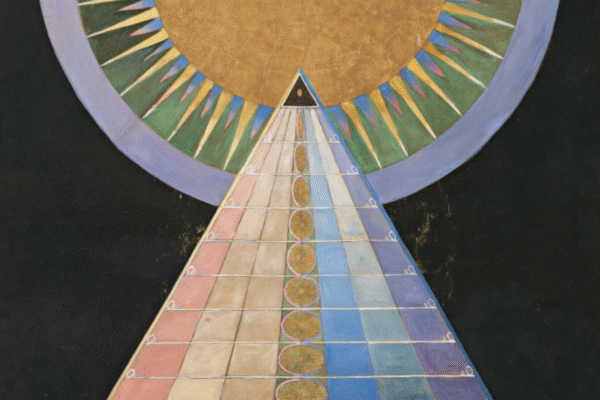
Artwork: Altarpiece #1, by Hilma af Klimt