
“No phenomenon is a real phenomenon until it is an observed phenomenon.”
— Niels Bohr
In quantum physics, the ‘observer effect’ refers to the way the act of measurement changes the thing being measured. At the subatomic level, this is not metaphor but law: observing a particle alters its behaviour. As physicist Werner Heisenberg wrote, “What we observe is not nature itself, but nature exposed to our method of questioning.” The very act of looking rearranges what is seen.
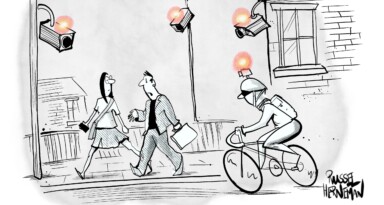
The same is true in our everyday lives. No observation is without consequence. Point a camera at a crowd, and people begin to perform. Ask a child to “act natural” and watch how quickly they stiffen. Even in solitude, the sense of being watched – by others, by unseen authority, by the imagined gaze of society – shapes what we do. The mirror of attention changes the one reflected within it.
Anthropologists working in remote communities have long recognised this “observer’s paradox”: that their presence alters what they are trying to record. The subject adapts to the gaze; behaviour bends under attention. In this way, observation is never pure, never weightless.
To recognise this is not to despair of objectivity, but to approach it from another angle. Every gaze carries a form of power; every witness leaves a trace. We are never simply watching – we are participating, altering, and prompting change just by being there.
To observe well is to know this, to see both outward and inward at once, aware that every act of looking, however small, shapes the field that it surveys. The light we cast, like that of a particle in motion, illuminates and disturbs in equal measure.