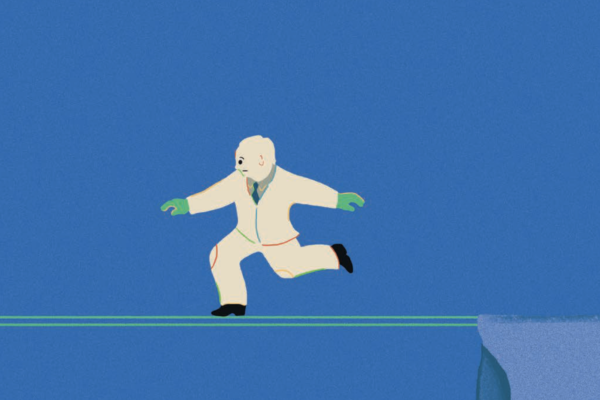


"The certainty-seeking mindset has a way of causing those trapped in it to miss out on their lives: it renders them allergic to the present, where uncertainty reigns."
When Vladimir Putin ordered Russian nuclear forces onto high alert, days after he invaded Ukraine, people far from the warzone began to report bone-deep feelings of uncertainty. Media accounts suggested a sudden spike in insomnia, and an epidemic of compulsive social media ‘doomscrolling’.
Meanwhile, anxious parents wondered how to discuss the unfolding crisis with their children, and the phrase “in these uncertain times” started cropping up in more than a handful of news stories and politicians’ speeches. Search Google’s digitised archive of scholarly and historical literature, though, and you’d find that phrase recurring in hundreds of journals and books, in almost every decade, back to
the 17th century. The belief that things are unprecedentedly uncertain right now, it turns out, is one that people almost always hold about the era in which they happen to live. “There is… the feeling that we live in a time of unusual insecurity,” wrote the spiritual teacher Alan Watts, in his book The Wisdom of Insecurity. “As the years go by, there seem to be fewer and fewer rocks to which we can hold, fewer things which we can regard as absolutely right and true, and fixed for all time.” Who today could disagree? But Watts was writing in 1951, a time generally remembered as one of peace and prosperity.
At the very least, this ought to give us pause. Of course, it might be the case that the world is genuinely becoming a more uncertain place with every successive year, thus vindicating each generation’s conviction that the present is more uncertain than the past. But another possibility is the one the writer C. S. Lewis articulated in a sermon delivered in London in the early days of World War II: that extreme uncertainty is humanity’s default state, and that circumstances just occasionally converge so as to allow us to forget it for a while. “The war creates no absolutely new situation,” Lewis told his audience. “It simply aggravates the permanent situation so that we can no longer ignore it. Human life has always been lived on the edge of a precipice.”
The truth, after all, is that we’re all going to die – at a time we’re unlikely to be able to predict – and that in the meantime anything at all could happen, at any moment, to ourselves or to anyone we care about. We are all inescapably vulnerable to events. You could walk out of a high-rise building tomorrow afternoon, and a grand piano could fall on your head from an apartment above.
Is that likely? Not remotely. But you can’t rule it out. And that tiny sliver of possibility is all that’s required for uncertainty to wreak its emotional distress. You desperately want to be sure about how things will turn out – and you definitely never can be.
One way of defining the phenomenon of worry, in fact, might be as the experience of frustration encountered in repeatedly trying, yet failing, to achieve a sense of certainty about the future. A trivial case in point: at the moment, my family and I are house-hunting, hoping to find an appropriate home in the rural area to which we moved last year, before our current temporary arrangement comes to an end.
Sometimes, I catch myself worrying about it: yearning to know that it’ll all work out and feeling the discomfort of the fact that I don’t know yet know if it will. And yet, by definition, I won’t know that it’ll work out until it already has worked out – whereupon, I suspect, I’ll find something else that hasn’t happened yet to fret about instead. The future is annoying like that: it can never be known with certainty from the vantage-point of the present, simply because it’s the future.
This is why respite from the distress of uncertainty can only be reached via a counterintuitive route: not by successfully eliminating the uncertainty, but by coming to see that the struggle to eliminate it is so completely futile that you might as well give it up entirely. We’re all in the same boat, being carried forward on the river of time, unable to know what’s around the next bend – and to treat that as a problem in need of a solution is to treat life itself as a problem, which is a recipe for nothing but anxiety. This helps explain the insight usually associated with Buddhist philosophy that the cause of our suffering isn’t to be found in the way life is, but in our deep emotional investment in wishing it were otherwise. Or as the American Zen teacher Charlotte Joko Beck liked to say: “What makes it unbearable is your mistaken belief that it can be cured.”
But now take one step further. What if learning to embrace uncertainty wasn’t just an unfortunate necessity – a tactic for reconciling oneself to the dispiriting truth of the human condition – but something actively positive, the precondition for a fulfilling life? The certainty-seeking mindset has a way of causing those trapped in it to miss out on their lives: it renders them allergic to the present, where uncertainty reigns, and intently focused on the future – where certainty might, they hope, prevail at last.
It was becoming a father that finally drove this home to me. At first, I agonised about what I should be doing – in terms of nutrition, or reading books, or sleep training, or screen time, or a thousand other variables endlessly dissected in the literature on parenting – until it finally dawned on me that approaching fatherhood in this manner would mean missing out on fatherhood entirely, to my son’s detriment and my own. Even if there were a ‘right way’ to approach any of these matters, I would only be able to evaluate the choices I’d made – and thus figure out if I’d chosen correctly – when my son was much older. My craving for a feeling of certainty about whether or not I was on the right track thus meant focusing my gaze on the future, instead of attending to my actual relationship with my son, which unfolded exclusively in the present. I came to realise that an authentic experience for both of us would only be found by engaging with what was happening now, and that seeking certainty got in the way of that – underscoring the insight of the psychoanalyst and philosopher Erich Fromm that “the quest for certainty blocks the search for meaning”.
The self-help writer Susan Jeffers once suggested an exercise for learning to embrace uncertainty: write down a list of the things you hope will come true in your lifetime – in your career, your relationships, or in the wider world – and then try rewriting them, this time replacing the phrase “I hope that…” with “I wonder if…” Hope, at least in this sense of the word, is a deeply conditional state of mind: it puts you in the position of anxiously waiting to see if your preferred outcomes will arrive, while intensifying your feelings of disappointment if they don’t. Wondering, by contrast, leaves you curious about what’s coming next, and at least potentially gratified or enriched by whatever ends up happening. You get to stop fighting for a sense of closure you’ll never attain, and relax into the inescapable, exhilarating openness of life as it actually is.